

Mass tort cases in Georgia can arise when dangerous drugs, defective medical devices, unsafe consumer products, toxic chemicals, or environmental hazards cause similar injuries to many people. Our Georgia mass tort lawyers represent injured individuals and families while pursuing accountability from manufacturers, pharmaceutical companies, and other corporations responsible for widespread harm.


When a dangerous drug, defective medical device, contaminated product, toxic chemical, or other hazardous product harms hundreds or thousands of people, taking on the corporation responsible can feel overwhelming. These cases may involve some of the largest pharmaceutical manufacturers, chemical companies, medical-device makers, and corporations in the country.
At Poulin + Willey Trial Lawyers, our Georgia mass tort lawyers help individuals and families in Atlanta, Albany, Athens, Augusta, Columbus, Macon, and throughout Georgia determine whether their injuries may be connected to widespread product-related or environmental harm and whether they may qualify for existing or developing mass tort litigation.
Mass torts are not the same thing as class actions. In a mass tort, multiple people may pursue individual claims arising from similar alleged wrongdoing, while each person’s injuries, medical history, damages, and potential recovery generally remain individually evaluated. By contrast, Georgia state-court class actions are governed by O.C.G.A. § 9-11-23.
These cases can require extensive scientific research, medical evidence, corporate records, expert witnesses, and nationwide litigation resources. That’s why our approach combines local Georgia representation with broader resources when the case demands them.
If you believe you were harmed by a dangerous drug, defective medical device, toxic substance, or other product affecting many people, Call Poulin + Willey Trial Lawyers.
FREE CASE EVALUATION | AVAILABLE 24/7 | NO FEE UNLESS WE WIN

Large corporations and their insurers may have enormous legal and financial resources devoted to defending mass tort litigation. If you’ve suffered a serious injury, you shouldn’t assume an early settlement program or offer reflects the full value of your individual losses. Our Georgia Mass Tort Lawyers evaluate your medical history, exposure, injuries, financial damages, and the circumstances surrounding your claim to help determine the appropriate legal strategy.
Our attorneys investigate Georgia Mass Tort Claims involving dangerous prescription drugs, defective medical devices, toxic chemicals, contaminated products, defective consumer products, environmental contamination, and other products or substances alleged to have caused widespread injuries. Because mass tort litigation changes over time, we evaluate each potential client’s circumstances to determine whether an active or developing litigation may apply.
Mass tort cases can require substantial financial, legal, medical, and scientific resources. Building these claims may involve reviewing millions of pages of corporate documents and working with physicians, toxicologists, epidemiologists, pharmacologists, engineers, scientists, economists, and other experts. Poulin + Willey Trial Lawyers combines local representation with broader resources to help Knoxville clients stand up to large corporations and institutional defendants.
You shouldn’t need a corporation’s financial resources to pursue accountability from one. Poulin + Willey Trial Lawyers offers a free case evaluation, and qualifying mass tort cases may be handled on a contingency-fee basis, meaning attorney fees are collected only if compensation is recovered. Call 800-777-7777 to discuss your potential claim and applicable fee arrangement.
Mass tort cases can depend heavily on documentation. Depending upon the litigation, useful evidence may include medical records, prescription histories, pharmacy records, product receipts, implant identification cards, operative reports, pathology reports, diagnostic imaging, employment records, exposure histories, photographs, product packaging, and other records connecting the plaintiff to the product or substance involved. If you suspect you may have a claim, don't intentionally discard potentially relevant evidence. For pharmaceutical claims, pharmacy and medical records can be especially important because they may document the exact medication, dosage, dates of use, and subsequent diagnosis. For environmental cases, residential and employment history may help establish where and when exposure allegedly occurred.
Mass tort claims frequently allege that a company designed an unsafe product, manufactured it improperly, failed to adequately investigate safety concerns, contaminated communities, or failed to provide appropriate warnings about known or reasonably discoverable risks. Proving liability depends on the facts and law governing the particular product or exposure; the existence of an injury or mass tort proceeding does not by itself establish that a company was negligent.
If a dangerous product, drug, device, chemical, or other substance caused your injuries, you may be able to pursue compensation for losses such as medical expenses, future treatment, lost wages, diminished earning capacity, pain and suffering, permanent impairment, and other damages permitted by applicable law. The damages available vary significantly by claim, jurisdiction, injury, and other circumstances, and Georgia law contains rules affecting certain categories of civil damages.
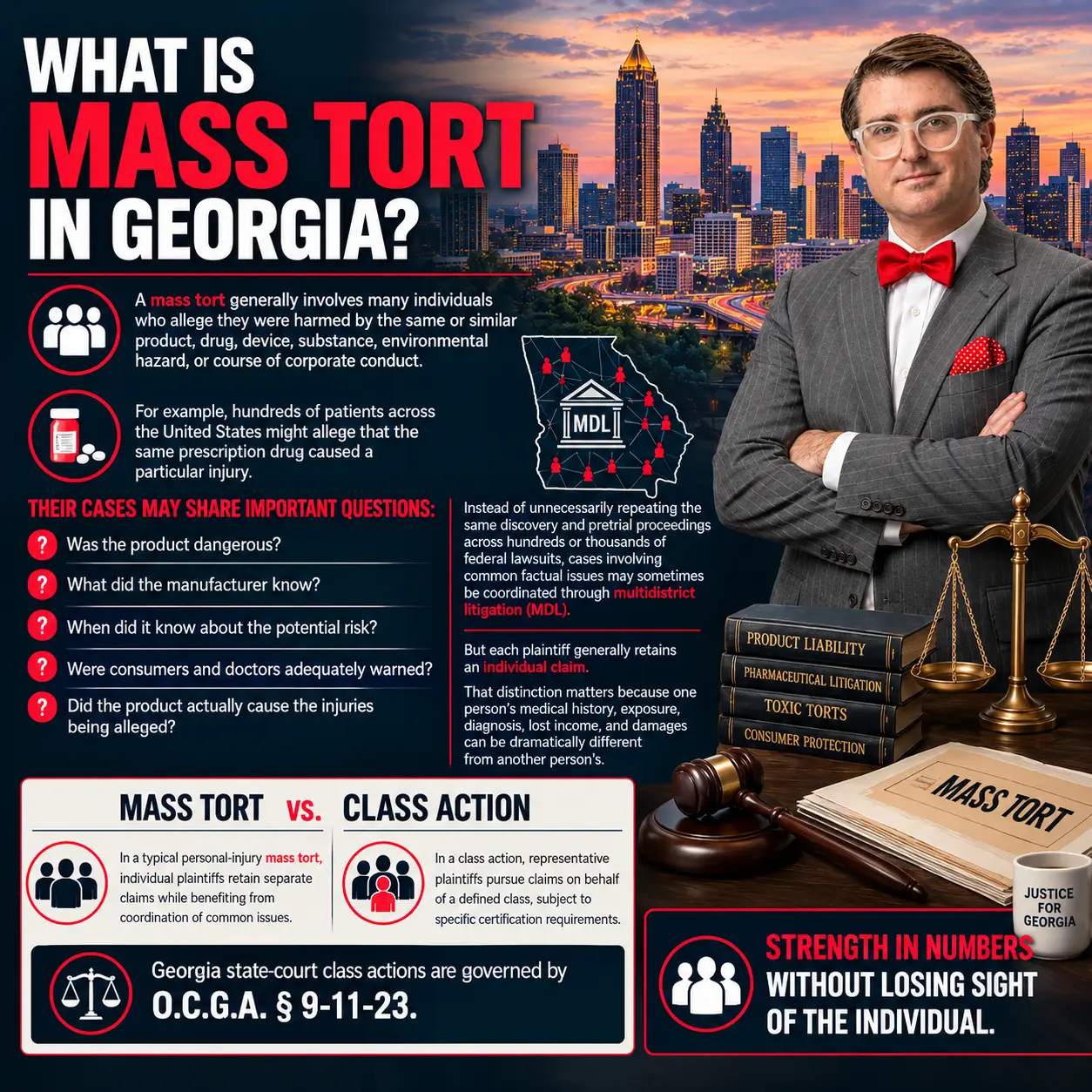
A mass tort generally involves numerous people who allege they were injured by the same or similar dangerous product, prescription drug, medical device, toxic substance, environmental exposure, or corporate conduct.
For example, patients in Georgia and across the United States may allege that the same prescription medication or medical device caused similar serious injuries.
Although each person’s circumstances are different, their cases may involve many of the same important questions:
When hundreds or thousands of federal lawsuits involve common factual questions, the cases may sometimes be coordinated through multidistrict litigation (MDL). MDL proceedings can consolidate certain discovery and pretrial matters rather than requiring courts and attorneys across the country to repeatedly address the same evidence and issues.
Importantly, however, each injured person generally maintains an individual claim. A Georgia plaintiff’s medical history, exposure, diagnosis, treatment, lost income, future medical needs, and other damages may be very different from those of another plaintiff.
Although the terms are sometimes confused, mass torts and class actions are not the same thing.
In a class action, one or more representative plaintiffs pursue claims on behalf of a larger defined group after satisfying specific requirements for class certification. Federal class actions are governed by Federal Rule of Civil Procedure 23, while Georgia state-court class actions are governed by O.C.G.A. § 9-11-23.
In a typical personal-injury mass tort, however, plaintiffs maintain their own individual claims while potentially benefiting from coordinated proceedings involving evidence and legal issues common to many cases.
For injured consumers in Atlanta and throughout Georgia, that can provide an important combination:
Although every litigation is different, a mass tort commonly begins when multiple people report similar injuries potentially associated with the same product or exposure.
Attorneys investigate the allegations and available scientific evidence. Lawsuits may then be filed individually.
When large numbers of federal cases share common factual questions, they may potentially be coordinated for certain pretrial proceedings. That can make discovery more efficient because attorneys do not need to independently litigate every common corporate issue from the beginning thousands of times.
Common issues might include:
Individual issues still matter.
A plaintiff may need to establish actual use or exposure, sufficient duration or dose when relevant, diagnosis, causation, and individual damages.
That’s why joining a mass tort isn’t simply filling out a form and waiting for a check.


Mass tort litigation may be national, but your injury is personal and local.
You may live in Savannah. Your doctors may be in Atlanta. Your medical records, employment history, pharmacy records, witnesses, and other important evidence may be located Augusta.
And the consequences of your injury are being experienced by you and your family here in Georgia.
Working with a local Georgia mass tort lawyer gives you an accessible legal team that understands the community while coordinating with broader resources when national litigation requires them.
Instead of feeling like claimant number 4,387 in litigation headquartered across the country, you should have someone who understands your individual story:
At Poulin + Willey Trial Lawyers, we live and work in the community we’re representing.
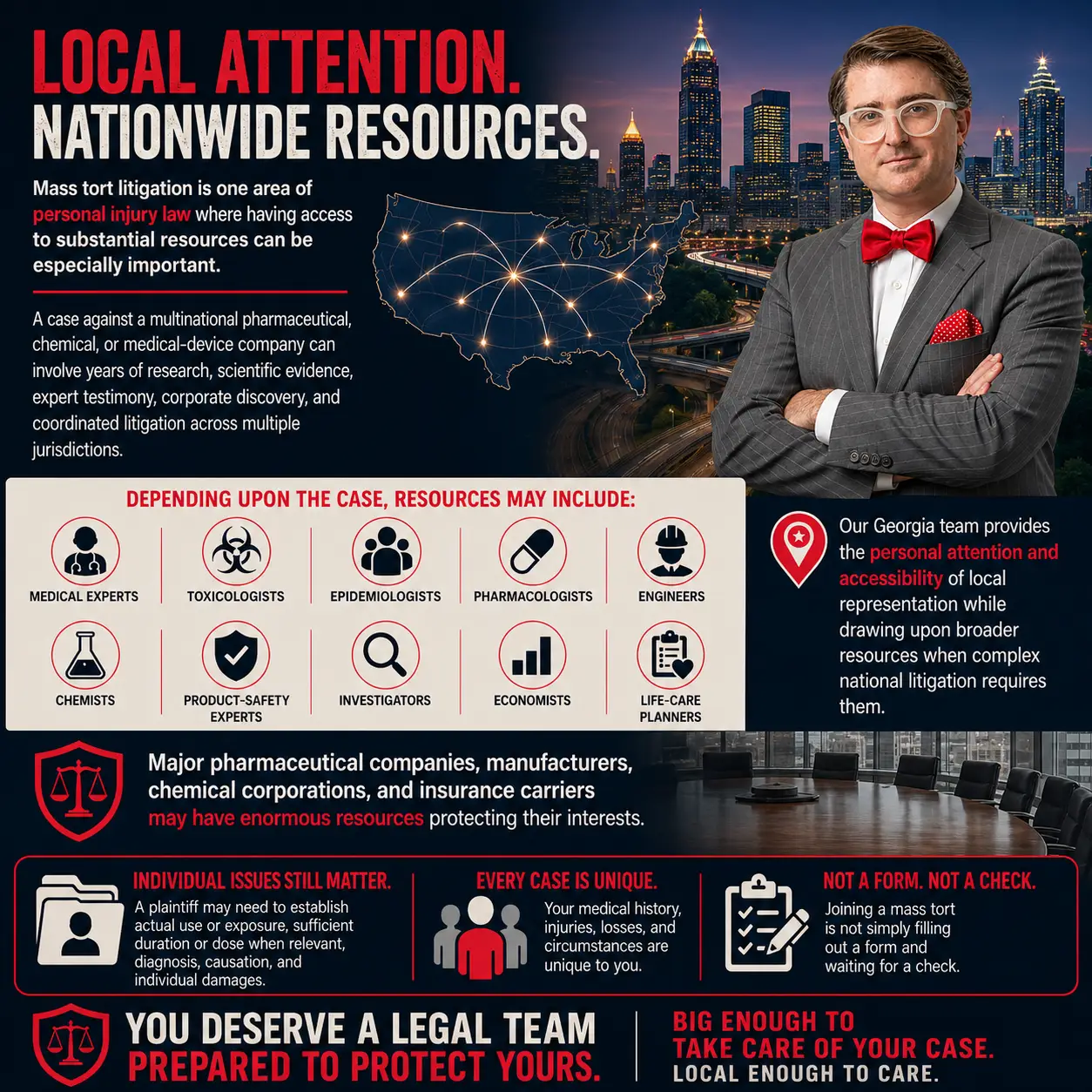
Mass tort litigation is one area of personal injury law where having access to substantial resources can be especially important.
A case against a multinational pharmaceutical, chemical, or medical-device company can involve years of research, scientific evidence, expert testimony, corporate discovery, and coordinated litigation across multiple jurisdictions.
Depending upon the case, resources may include:
Medical experts • Toxicologists • Epidemiologists • Pharmacologists • Engineers • Chemists • Product-safety experts • Investigators • Economists • Life-care planners
Our Knoxville team provides the personal attention and accessibility of local representation while drawing upon broader resources when complex national litigation requires them.
Major pharmaceutical companies, manufacturers, chemical corporations, and insurance carriers may have enormous resources protecting their interests.

There are national advertisements everywhere for mass tort claims.
We believe East Tennesseans deserve more than a toll-free intake center.
Local Knoxville Representation: We live and work in the community we’re representing.
Individual Claim Evaluation: We evaluate your product use or exposure, medical diagnosis, timeline, evidence, and potential damages.
Mass Tort Resources: Complex litigation may require medical professionals, scientists, toxicologists, investigators, economists, and other specialists.
Evidence-Driven Investigation: We work to establish the connection between the product or exposure and your individual injuries rather than assuming participation in litigation proves causation.
Corporate Accountability: We help individuals pursue claims against manufacturers and other entities when evidence and applicable law support liability.
Personalized Attention: You’re not a case inventory number. We want to understand what happened to you.
24/7 Availability: You can contact us 24 hours a day, seven days a week.
Free Case Evaluation: It costs nothing to tell us what happened and determine whether your circumstances warrant further investigation.
No. While both can involve many people with related claims, they are different legal mechanisms. Class actions use representative plaintiffs and require class certification; mass tort plaintiffs typically retain individual personal-injury claims even when common aspects of their cases are coordinated. Georgia state-court class actions are governed by O.C.G.A. § 9-11-23.
No. Using a particular medication or product doesn’t automatically establish a claim. Eligibility can depend on documented use, the injury diagnosed, timing, causation, applicable law, and criteria relevant to the particular litigation.
It depends. Some mass tort claims resolve through negotiated settlements, while others may be dismissed, tried individually, or resolved through other procedures. No attorney can responsibly guarantee how a particular claim will end.
There is no universal settlement value. The potential value depends on factors including the product or exposure, injury severity, medical evidence, causation, treatment, lost earnings, permanent impairment, applicable law, available defendants, and the particular litigation.
Potentially. Mass torts frequently involve plaintiffs from many states. Where a lawsuit can or should be filed and which law applies depends on the facts of the particular case.
Yes. Statutes of limitation and repose can apply, but the correct deadline depends on the type of claim, product, injury, date of discovery, jurisdiction, and other circumstances. Don’t assume that because a national mass tort is still being advertised that your individual claim remains timely.