

When healthcare providers in Tennessee make preventable mistakes, patients suffer. Our Knoxville medical malpractice lawyers help victims recover compensation for misdiagnosis, surgical errors, and negligent care.


We trust doctors, nurses, hospitals, surgeons, pharmacists, and other healthcare professionals with our health and our lives. When that trust is broken because a healthcare provider fails to meet the applicable standard of care, the consequences can be devastating.
A missed diagnosis can allow cancer to progress. A surgical mistake can cause permanent disability. A medication error can damage vital organs. A preventable birth injury can affect a child and family for a lifetime.
At CallSevensTennessee.com, our Knoxville medical malpractice lawyers represent patients and families harmed by potential medical negligence in Knoxville, Knox County, and communities throughout East Tennessee. We investigate what happened, obtain and analyze medical records, consult qualified medical professionals when appropriate, and determine whether the evidence supports a Tennessee health care liability claim.
Medical malpractice cases are among the most complex personal injury claims. Tennessee also imposes specific procedural requirements on many health care liability actions, including pre-suit notice and, in cases requiring expert testimony, a certificate of good faith.
That makes experienced legal guidance especially important.
CallSevensTennessee.com combines local Knoxville representation with the support and resources available through a nationwide personal injury law firm.
If you believe you or someone you love was seriously injured because of medical negligence, CallSevensTennessee.com
FREE CASE EVALUATION | AVAILABLE 24/7 | NO FEE UNLESS WE WIN

Medical malpractice injuries can create enormous financial consequences, particularly when a patient needs additional surgeries, rehabilitation, long-term treatment, or lifelong care. Hospitals, healthcare organizations, providers, and their insurers may aggressively defend these claims. Our Knoxville medical malpractice lawyers investigate the full extent of your injuries and losses before pursuing compensation, rather than allowing an early settlement offer to define what your future is worth.
Medical negligence can occur in an emergency room, hospital, surgical center, physician’s office, pharmacy, nursing facility, or other healthcare setting. We investigate potential Knoxville medical malpractice claims involving surgical errors, misdiagnosis, delayed diagnosis, birth injuries, medication mistakes, anesthesia errors, hospital negligence, stroke-related malpractice, preventable amputations, and other serious medical errors.
Successful medical malpractice cases depend on evidence, preparation, and an understanding of complicated medical issues. Depending on the circumstances, a claim may require analysis by physicians, surgeons, nurses, pharmacists, medical specialists, economists, vocational professionals, and life-care planners. Our team works to develop the medical and financial evidence necessary to demonstrate what happened, why it happened, and how the injury could affect the patient for years to come.
A preventable medical injury can leave your family facing additional treatment, lost income, rehabilitation costs, and an uncertain future. You shouldn’t have to add upfront attorney fees to that burden. CallSevensTennessee.com provides free case evaluations, and qualifying medical malpractice cases are handled on a contingency-fee basis—meaning attorney fees are collected only if compensation is recovered. Call 800-777-7777 anytime to discuss your potential claim.
Every year, hundreds of thousands of people in the United States suffer injuries due to medical malpractice. While an exact national total is difficult to pin down because many medical errors go unreported, widespread public health studies indicate the crisis is severe. A frequently cited study by Johns Hopkins University patient safety experts estimates that medical errors cause more than 250,000 deaths annually in the U.S., ranking as the third leading cause of death behind heart disease and cancer. Other healthcare studies, including research published by the Journal of Patient Safety, suggest that preventable adverse events in hospitals contribute to the injury or death of 400,000 or more patients each year. Despite these massive figures, National Practitioner Data Bank statistics show that only a small fraction of injured patients actually secure financial payouts each year, demonstrating a significant gap between the occurrence of medical negligence and formal legal resolution.
A poor medical outcome does not automatically mean malpractice occurred. A potential medical malpractice claim instead focuses on whether a healthcare provider failed to meet the applicable standard of care and whether that failure caused an injury. Errors involving diagnosis, surgery, medication, anesthesia, monitoring, treatment, or childbirth can have life-changing consequences when the evidence establishes that negligent medical care caused preventable harm.
When medical negligence causes an injury, Tennessee law may allow a patient to pursue compensation for losses attributable to that malpractice. Depending on the circumstances, recoverable damages may involve additional medical expenses, future treatment, lost wages, diminished earning capacity, pain and suffering, permanent impairment, disability, and other legally recoverable losses. In fatal cases, surviving family members may have potential wrongful death claims. The damages available depend on the facts and Tennessee law applicable to the individual case.
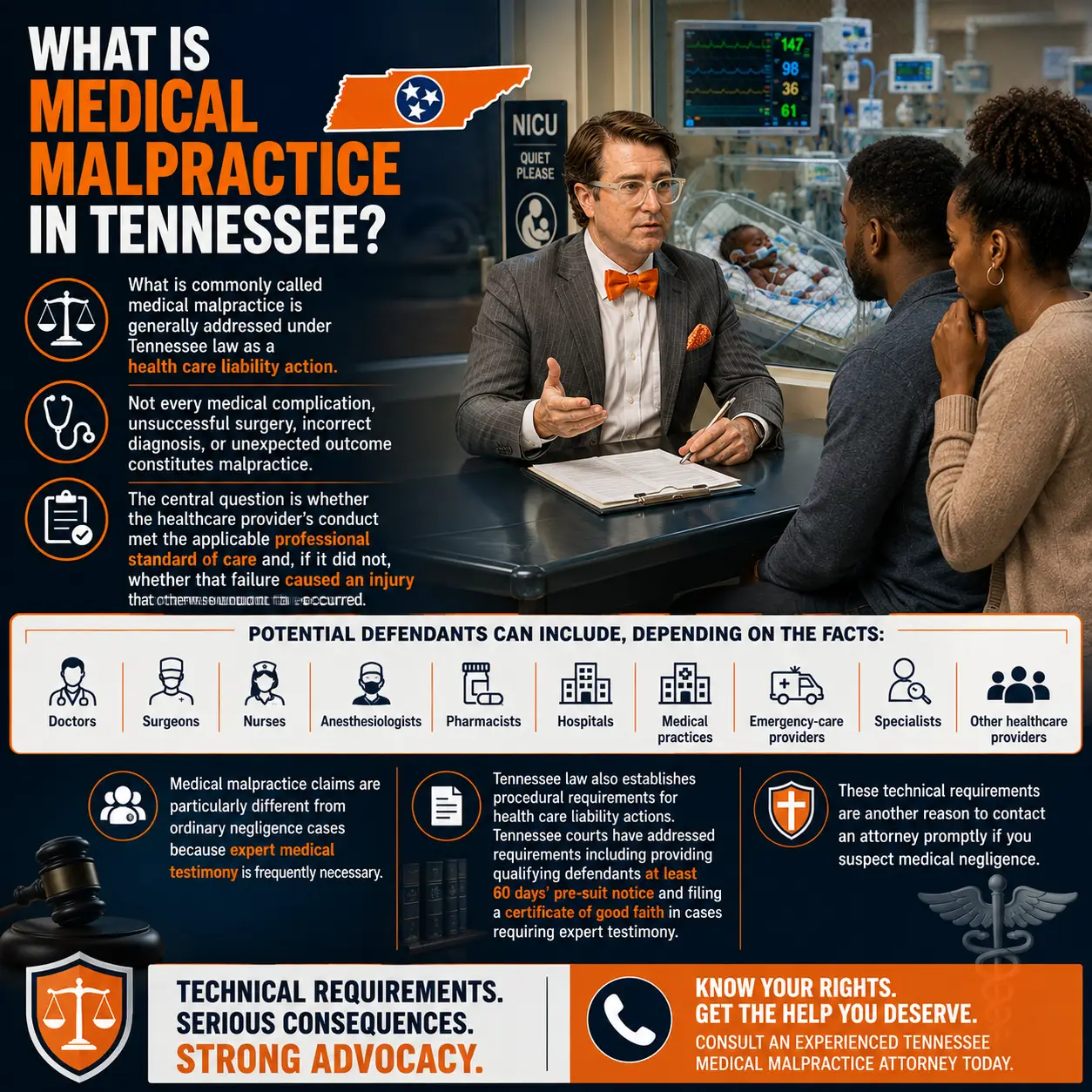
What is commonly called medical malpractice is generally addressed under Tennessee law as a health care liability action.
Not every medical complication, unsuccessful surgery, incorrect diagnosis, or unexpected outcome constitutes malpractice.
The central question is whether the healthcare provider’s conduct met the applicable professional standard of care and, if it did not, whether that failure caused an injury that otherwise would not have occurred.
Potential defendants can include, depending on the facts:
Doctors • Surgeons • Nurses • Anesthesiologists • Pharmacists • Hospitals • Medical practices • Emergency-care providers • Specialists • Other healthcare providers
Medical malpractice claims are particularly different from ordinary negligence cases because expert medical testimony is frequently necessary. Tennessee law also establishes procedural requirements for health care liability actions. Tennessee courts have addressed requirements including providing qualifying defendants at least 60 days’ pre-suit notice and filing a certificate of good faith in cases requiring expert testimony.
These technical requirements are another reason to contact an attorney promptly if you suspect medical negligence.
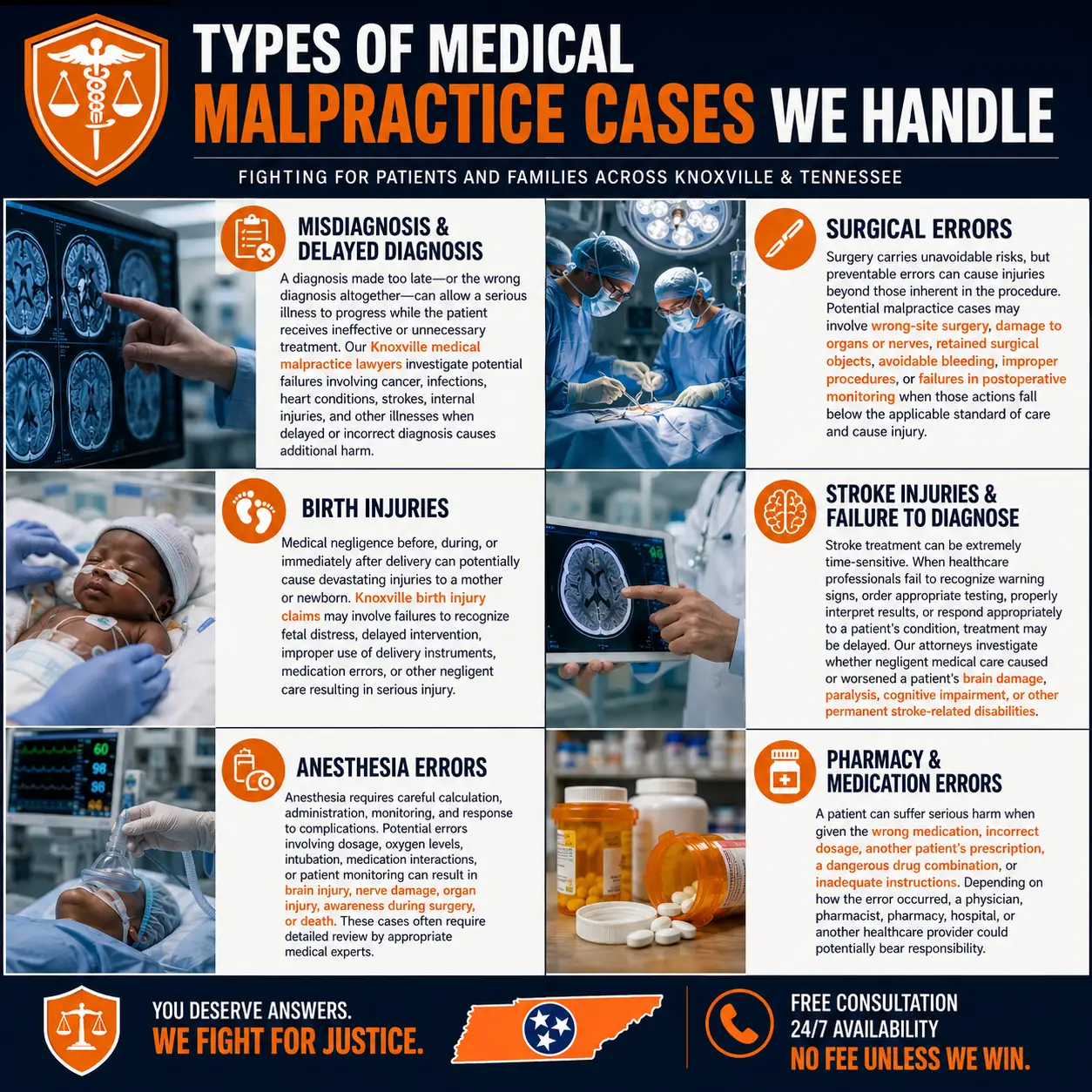
A diagnosis made too late—or the wrong diagnosis altogether—can allow a serious illness to progress while the patient receives ineffective or unnecessary treatment. Our Knoxville medical malpractice lawyers investigate potential failures involving cancer, infections, heart conditions, strokes, internal injuries, and other illnesses when delayed or incorrect diagnosis causes additional harm.
Surgery carries unavoidable risks, but preventable errors can cause injuries beyond those inherent in the procedure. Potential malpractice cases may involve wrong-site surgery, damage to organs or nerves, retained surgical objects, avoidable bleeding, improper procedures, or failures in postoperative monitoring when those actions fall below the applicable standard of care and cause injury.
Medical negligence before, during, or immediately after delivery can potentially cause devastating injuries to a mother or newborn. Knoxville birth injury claims may involve failures to recognize fetal distress, delayed intervention, improper use of delivery instruments, medication errors, or other negligent care resulting in serious injury.
Stroke treatment can be extremely time-sensitive. When healthcare professionals fail to recognize warning signs, order appropriate testing, properly interpret results, or respond appropriately to a patient’s condition, treatment may be delayed. Our attorneys investigate whether negligent medical care caused or worsened a patient’s brain damage, paralysis, cognitive impairment, or other permanent stroke-related disabilities.
Anesthesia requires careful calculation, administration, monitoring, and response to complications. Potential errors involving dosage, oxygen levels, intubation, medication interactions, or patient monitoring can result in brain injury, nerve damage, organ injury, awareness during surgery, or death. These cases often require detailed review by appropriate medical experts.
A patient can suffer serious harm when given the wrong medication, incorrect dosage, another patient’s prescription, a dangerous drug combination, or inadequate instructions. Depending on how the error occurred, a physician, pharmacist, pharmacy, hospital, or another healthcare provider could potentially bear responsibility.
An avoidable amputation can permanently change a person’s mobility, independence, career, and quality of life. Medical negligence involving untreated infections, vascular problems, surgical errors, delayed diagnoses, or improper postoperative care may sometimes contribute to loss of a limb. Our attorneys investigate the medical evidence to determine whether the amputation could have been prevented through appropriate care.
Hospitals and emergency departments treat patients under challenging circumstances, but applicable standards of care still matter. Potential claims can involve inadequate monitoring, delayed treatment, communication failures, medication mistakes, improper discharge, diagnostic failures, staffing-related negligence, or failure to respond to a deteriorating patient.

When you’re questioning whether the medical care you received caused a devastating injury, you shouldn’t have to explain Knoxville and East Tennessee to a law firm operating hundreds of miles away.
A local Knoxville medical malpractice lawyer understands the community where you live, where your medical care occurred, and where you may continue receiving treatment.
Knoxville serves as a major healthcare center for East Tennessee. Patients from Knox County and surrounding communities frequently travel into Knoxville for emergency care, surgery, specialty treatment, diagnostic testing, rehabilitation, and other medical services.
A local attorney can understand the regional healthcare landscape while giving clients something equally important:
Medical malpractice cases can last considerably longer than the medical event that caused them. You deserve a legal team that communicates with you, understands how the injury has affected your family, and treats you like a person rather than a case number.
At CallSevensTennessee.com, we live and work in the community we’re representing.
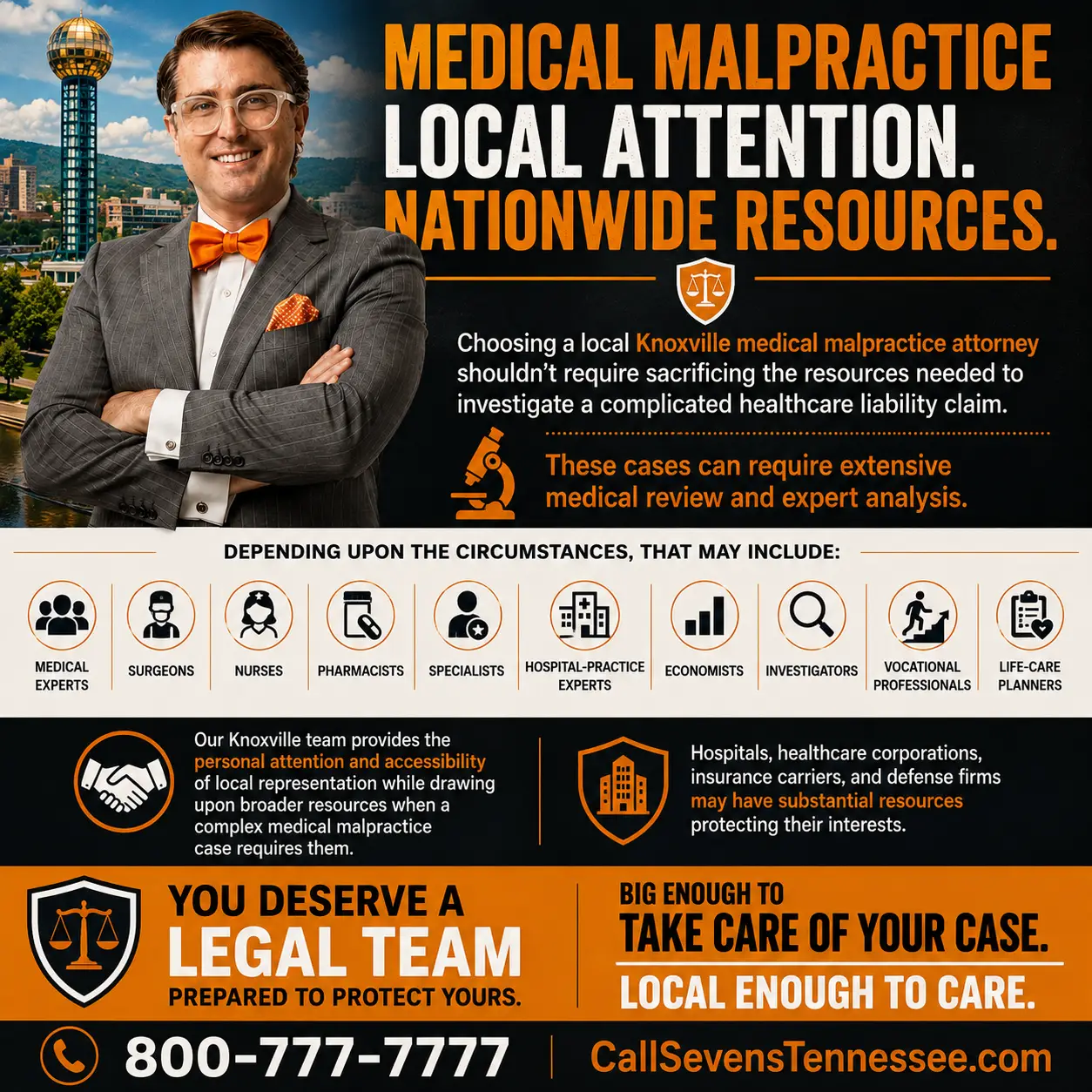
Choosing a local Knoxville medical malpractice attorney shouldn’t require sacrificing the resources needed to investigate a complicated healthcare liability claim.
These cases can require extensive medical review and expert analysis.
Depending upon the circumstances, that may include:
Medical experts • Surgeons • Nurses • Pharmacists • Specialists • Hospital-practice experts • Economists • Investigators • Vocational professionals • Life-care planners
Our Knoxville team provides the personal attention and accessibility of local representation while drawing upon broader resources when a complex medical malpractice case requires them.
Hospitals, healthcare corporations, insurance carriers, and defense firms may have substantial resources protecting their interests.
Big enough to take care of your case. Local enough to care.
There are plenty of law firms advertising medical malpractice services to Knoxville residents.
We believe injured East Tennesseans deserve something different:
Local Knoxville Representation: We live and work in the community we’re representing.
Medical Malpractice Investigation: We examine the medical care, records, timeline, providers involved, resulting injury, and other evidence relevant to determining whether malpractice may have occurred.
Access to Appropriate Resources: Complex claims may require physicians, specialists, investigators, economists, vocational experts, and life-care planners.
Personalized Attention: You’re a patient and a person—not a medical malpractice claim number.
Evidence-Driven Representation: Medical malpractice cases depend upon evidence. We work to understand what happened medically and connect that evidence to the patient’s injuries and losses.
Prepared for Litigation: Healthcare providers and their insurers may vigorously defend malpractice claims. Your case should be prepared accordingly.
24/7 Availability: You can contact us 24 hours a day, seven days a week.
Free Case Evaluation: It costs nothing to tell us what happened and determine whether your circumstances warrant further investigation.
Medicine cannot guarantee successful outcomes. A complication or unsuccessful treatment does not automatically establish negligence. Medical malpractice generally requires evidence that a provider failed to meet the applicable standard of care and that the failure caused compensable harm.
Depending on the facts, potential defendants can include physicians, surgeons, nurses, anesthesiologists, pharmacists, hospitals, medical practices, and other healthcare providers or entities.
Available damages depend on the circumstances and Tennessee law. A claim may potentially seek compensation for additional medical costs, lost income, diminished earning capacity, pain and suffering, disability, and other recoverable losses. Tennessee law also imposes rules affecting damages in health care liability cases, so the specifics should be evaluated individually.
Many Tennessee health care liability cases require expert testimony, and Tennessee law requires a certificate of good faith with the complaint in cases in which expert testimony is required, subject to the statute’s provisions.
When medical negligence causes a patient’s death, qualifying surviving family members or the appropriate representative may be able to pursue a wrongful death claim. These cases require careful evaluation of both Tennessee health care liability and wrongful death law. common, and often preventable, causes of catastrophic events:
Bridges, roads, parking garages, dams, and buildings all require ongoing inspections and upkeep to remain safe. When governments, property owners, or corporations fail to maintain infrastructure, the results can be devastating.
Deferred maintenance on bridges can lead to structural failures and sudden collapse, and aging pipelines or electrical systems that go unrepaired can spark fires or explosions.
In many cases, warning signs, like visible cracks, rust, or past inspection failures, are ignored until it’s too late.
Planes, trains, and commercial trucks operate within complex systems where a single mistake can result in mass casualties.
Operator fatigue or distraction, especially in trucking and rail industries, can cause catastrophic collisions. Failure to follow safety protocols or miscommunication between controllers and operators can also lead to disasters.
With proper training, oversight, and technology safeguards, many transportation-related tragedies could be avoided.
While natural disasters like hurricanes and wildfires can’t be stopped, the level of damage they cause often depends on how well communities are prepared.
Lack of evacuation plans, early warning systems, or storm-resistant infrastructure can turn a manageable crisis into a mass casualty event. Additionally, failure to secure hazardous materials during a natural disaster can lead to secondary disasters like chemical spills or fires.
From high-rise buildings to residential homes, construction that fails to meet safety standards is a ticking time bomb.
Substandard materials, shortcuts during building, or ignoring building codes can lead to collapses and falling debris. Improper installation of heavy equipment like cranes or balconies can also result in sudden structural failures.
Developers and contractors have a legal and ethical responsibility to build safely and follow regulations, but all too often, cost-cutting takes precedence over safety.
In many industries, catastrophic events stem from profit-driven decisions that put lives at risk.
Failing to invest in safety systems or proper employee training to cut costs and ignoring known risks to avoid liability or delays in production are common ways that cheap businesses put others at risk.
Cutting corners might save money in the short term, but it can cost lives in the long run.
Regulations are in place to protect the public, but when agencies fail to enforce them, or look the other way, disasters can follow.
Infrequent inspections, weak penalties, and industry lobbying can result in unsafe conditions being allowed to persist.
Your initial case evaluation is free. Qualifying cases are handled on a contingency-fee basis, so attorney fees are collected only if compensation is recovered.